The Project
DOMINA: Revisiting Women’s History in Milan Over 2,000 Years
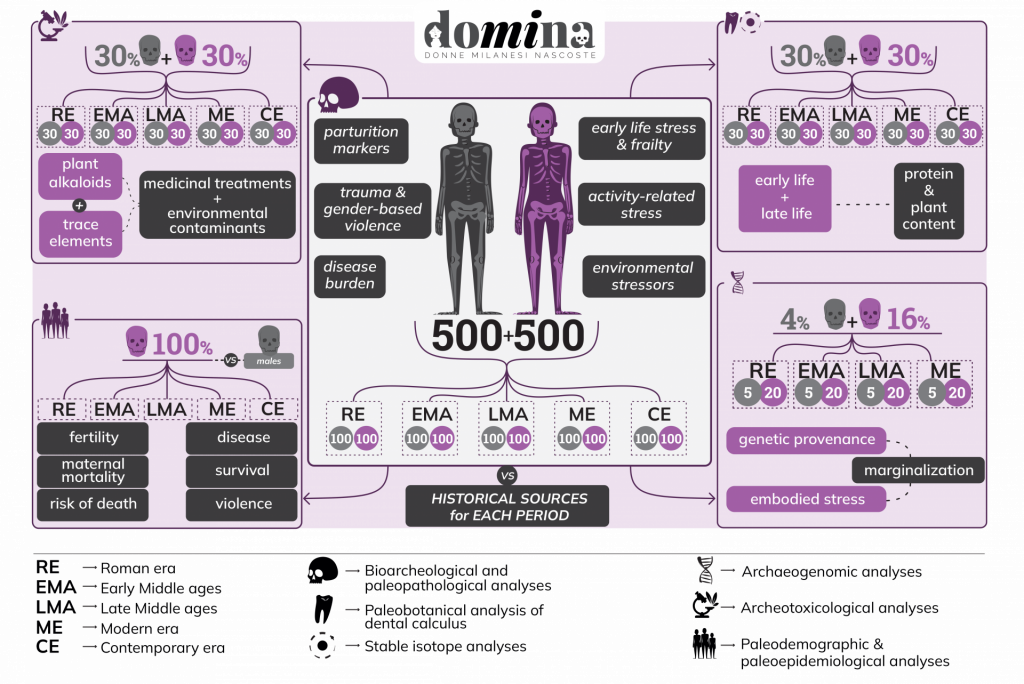
DOMINA is an ambitious interdisciplinary research project that aims to reconstruct women’s lives in Milan over two millennia through the integration of bioarchaeology, paleopathology, isotopic and archaeotoxicological analyses, paleobotany, paleodemography, and paleoepidemiology, combined with historical research.
Led by Dr. Lucie Biehler-Gomez, Assistant Professor at the Laboratory of Forensic Anthropology and Odontology (LABANOF), Department of Biomedical Sciences for Health, University of Milan, the project is funded by the Italian Ministry of University and Research (MUR) through the Fondo Italiano per la Scienza (FIS) program.
Through the study of 1,000 skeletal remains (100 females and 100 males across five historical periods: Roman [1st–5th c. CE], Early Medieval [6th–10th c. CE], Late Medieval [11th–15th c. CE], Modern [16th–18th c. CE], and Contemporary [19th–20th c. CE]), DOMINA investigates women’s health, diet, work, and social roles — aspects often omitted or distorted in traditional historical narratives.
Scientific and Social Aims
DOMINA addresses six interdisciplinary objectives designed to uncover the biological and social dimensions of women’s lives over time:
- Examine Gendered Health Disparities Over 2,000 Years
Through bioarchaeology and paleopathology, DOMINA investigates physiological and environmental stress markers, disease patterns, and evidence of gender-based violence, reconstructing how health and work shaped women’s lived experiences. - Reconstruct Women’s Diets Over Time
Isotopic and paleobotanical analyses of dentine collagen and dental calculus reveal what women ate, how nutrition varied by class, age, and gender, and how social and economic changes affected access to resources. - Assess Medical Treatments and Environmental Exposure
Archaeotoxicological analyses trace plant alkaloids, heavy metals, and xenobiotics to uncover gendered medical practices, self-care strategies, and exposure to environmental contaminants. - Analyze Diachronic Changes in Mortality, Health, and Violence
Using paleodemography and paleoepidemiology, DOMINA examines fertility, maternal mortality, and violence, identifying historical periods of improvement or decline in women’s survival and well-being. - Investigate Differential Treatment of Foreign Women
Genetic provenance (aDNA) reveals whether women of non-local ancestry experienced discrimination or marginalization, linking biological stress markers to social identity and inequality. - Compare Bioarchaeological Findings with Historical Sources
Integrating scientific and documentary data, DOMINA evaluates how women’s experiences were represented — or silenced — in written history, providing a more balanced reconstruction of the past.
Impacts
DOMINA is poised to generate transformative scientific and societal impacts by offering an unprecedented, comprehensive, and more nuanced perspective of women’s lived experiences in Milan over 2,000 years, reshaping gender and societal narratives.
Scientific Impacts
- Establishes the first interdisciplinary framework for the long-term study of women’s condition in Europe, integrating biological, historical, and scientific data.
- Generates open-access datasets on health, diet, and isotopes to advance comparative studies across Europe.
- Expands methodological boundaries of bioarchaeology, paleopathology and archaeotoxicology, strengthening their role in gender-focused research.
Societal Impacts
- Challenges traditional historical narratives by restoring women to the center of human history.
- Offers a gender-inclusive model for interpreting past societies, informing contemporary discussions on inequality and resilience.
- Promotes public engagement and awareness, showing how science can amplify the voices of women silenced by time.
Why DOMINA Matters
History that does not consider women is, by definition, not a full history. Traditional history has often centered on men’s experiences, leaving women’s stories fragmented or erased. DOMINA challenges this imbalance by combining scientific evidence and historical records to reveal women’s lived experiences, from health and labor to resilience and inequality across 2,000 years.
By giving voice to women long silenced by time, DOMINA not only rewrites history but also provides insights to understand modern gender disparities, showing how the past still shapes our present, and paves the way to build a fairer, more equitable, and more empowered future.